
Note: This post first appeared as “Tokyo Canvas Takedown: T-Shirt Design Theft and How I Fought Back“ on Pyragraph: Culture, Career, How-To | Grassroots Media for Artists & Indies. I wanted to share the story with you here and also tell you about my October giveaway at the bottom of the page.
“Holy shit, they stole your art!”
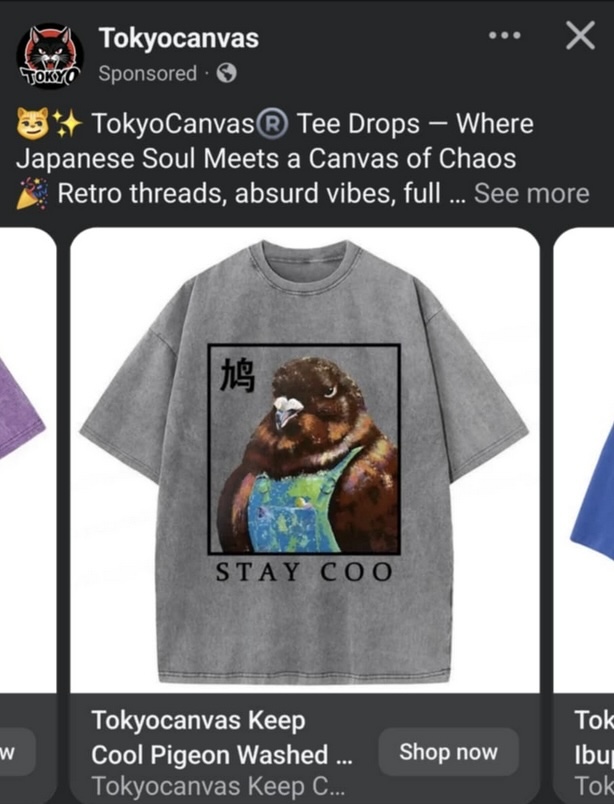
I discovered that one-line message when I opened Facebook a few months ago. A friend sent it, along with a screenshot of an ad that had randomly appeared in her feed.
Tokyo Canvas (a Chinese company made to look like a Japanese Company) ripped off the design I created for Palomacy Pigeon & Dove Adoptions and put it on a T-shirt for sale through their website.
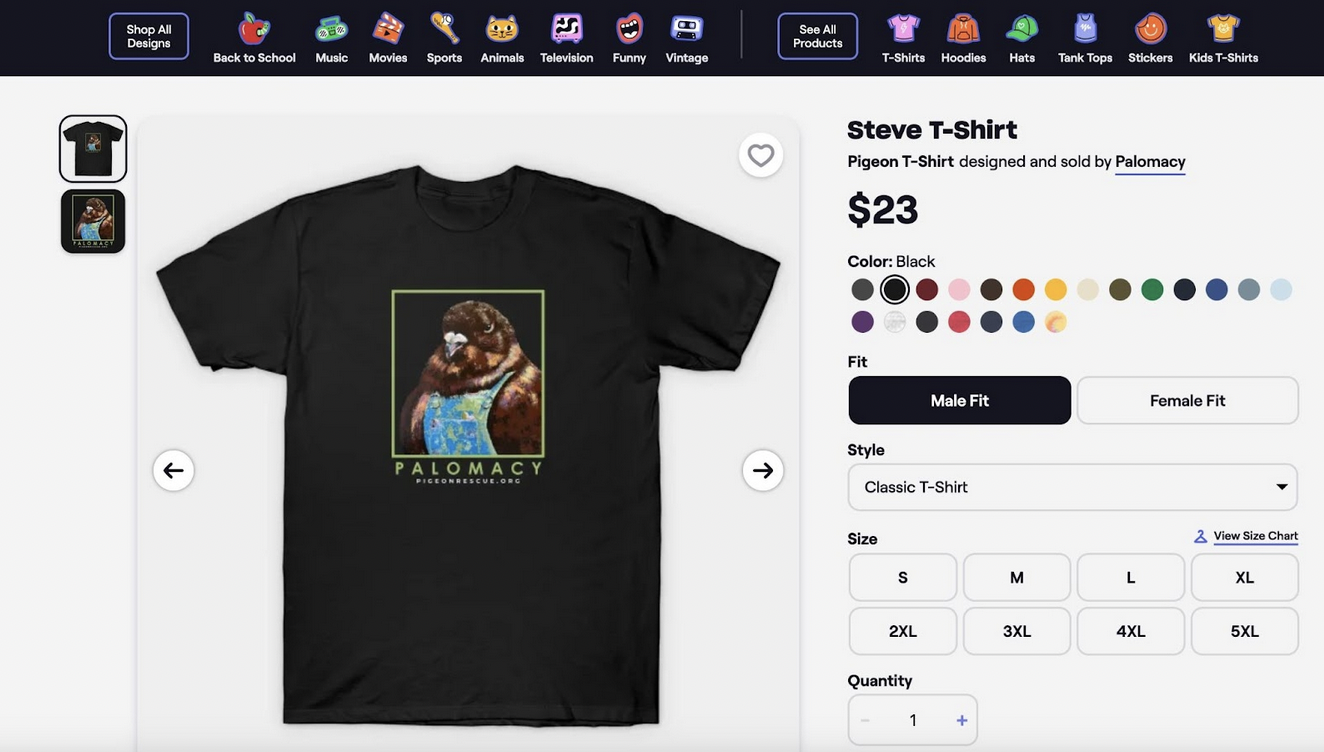
Here’s the Palomacy design featuring my portrait of rescued Show King pigeon Steve:
And here’s the Tokyo Canvas ripoff:
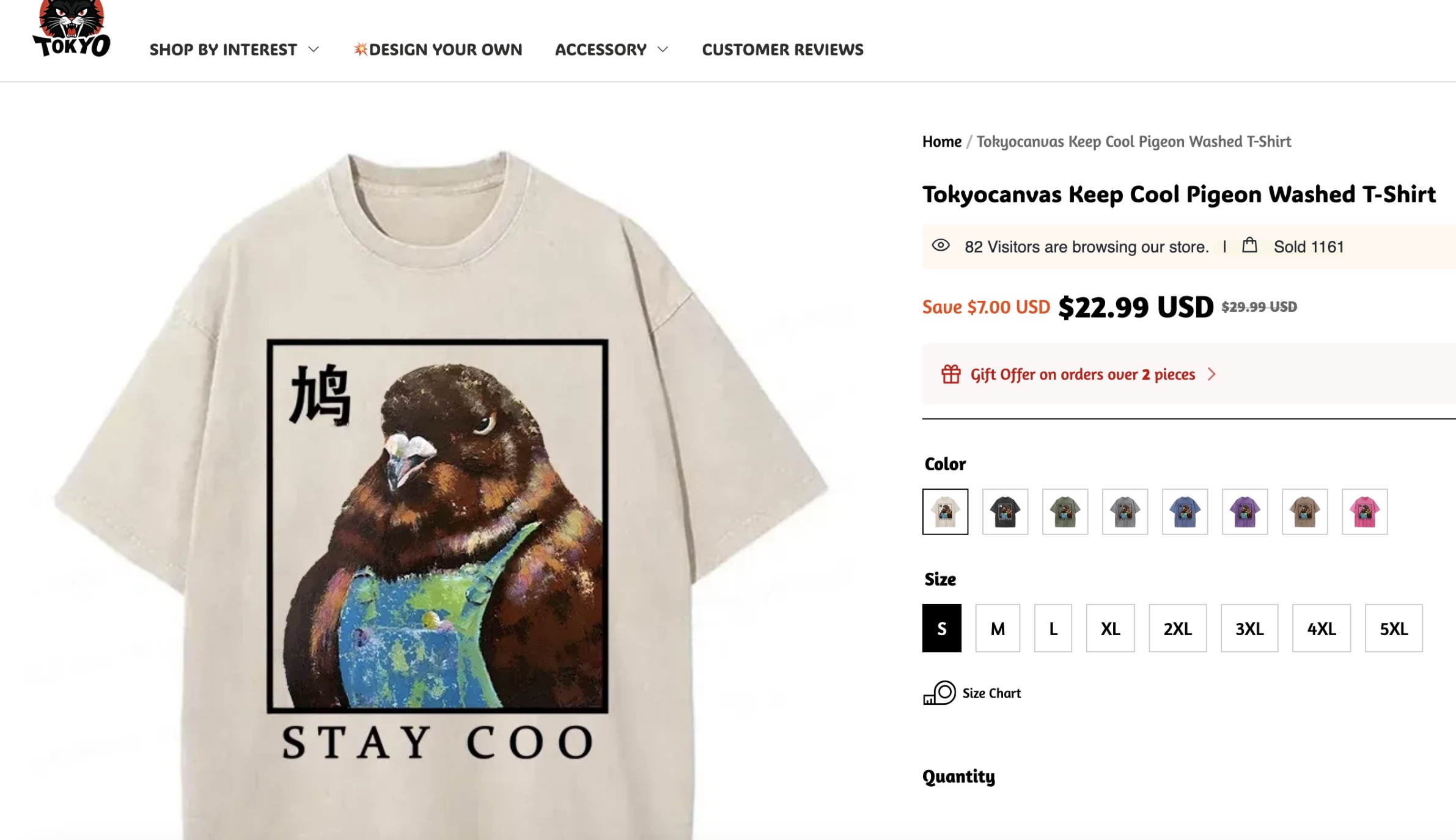
Needless to say, I did not “STAY COO.”
My Art Was Stolen! What Do I Do?
I was surprised by people who implied that there was nothing I could do to stop a T-shirt company from stealing my art because “it happens all the time.” Indeed, T-shirt design theft by overseas companies is rampant—but that didn’t mean I’d accept it.
Thankfully, many other people were outraged on my behalf and wanted to help me fight back. Together, we got Tokyo Canvas to take down the Facebook ads and sales page within 48 hours. For anyone reading this who faces a similar situation, I’d like to outline the takedown process that worked for me.
When Someone Steals Your Art or Design: Calm Down, Make a Plan, Get Help
When I saw Steve in a Facebook ad for someone else’s shirt, I was so shocked that my mind exploded like a seed pod, flinging anxious thoughts in all directions. I didn’t know where to start.
Know Your Rights
Reminding myself that I am, technically, a lawyer, I began with what I already knew: Tokyo Canvas committed a copyright law violation. An artist owns the copyright in their original work from the moment they create it. I didn’t have to register Steve with the U.S. Copyright Office or add a © to establish myself as the copyright owner, although:
- registration or a copyright mark may discourage theft, and
- I would have to register if I wanted to sue someone.
Prepare a DMCA Takedown Notice
After some quick research, I discovered that I could send Tokyo Canvas a DMCA takedown notice. DMCA stands for “Digital Millennium Copyright Act.” The DMCA was passed in 1998 to govern certain aspects of copyright law as it relates to the Internet.
The takedown notice informs the infringing company (and possibly its domain registrar or website host) that it’s violating a creator’s rights. It instructs them, more or less, to knock it off. Once the company receives your notice, it must remove or prohibit access to the copyrighted work or send you a counter-notice stating why it believes it can legally use your work. To be valid, the notice needs to contain specific elements outlined by the U.S. Copyright Office. You can find a sample notice on the DMCA Notice and Takedown page of the U.S. Copyright Office website.
Because this type of theft does “happen all the time,” Tokyo Canvas already has a dedicated page on its website to receive DMCA notices and related intellectual property complaints. The existence of this page suggests that companies like Tokyo Canvas subsist on profits from stolen artwork. If an artist notices a theft and complains, they’ll take down the offending page. However, most artists will never know, allowing these companies to play an extended game of “whack-a-mole” with artists, making money off stolen work with impunity.
At this point, I had armed myself with information about the DMCA notice. I was also discussing the problem with Rich Stim, a friend and colleague who is an intellectual property lawyer for creatives. Rich’s clear advice settled my agitated brain. He was also able to draft a professional DMCA takedown notice on my behalf. However, we didn’t submit the notice on that first day. My Facebook friends had other ideas.
Crowdsource Your Clap Back
As I reviewed the legal terrain, I was also bitching with a group of friends in a private Facebook chat. You couldn’t call it a plan, but our collective indignation resulted in a series of actions that proved surprisingly effective.
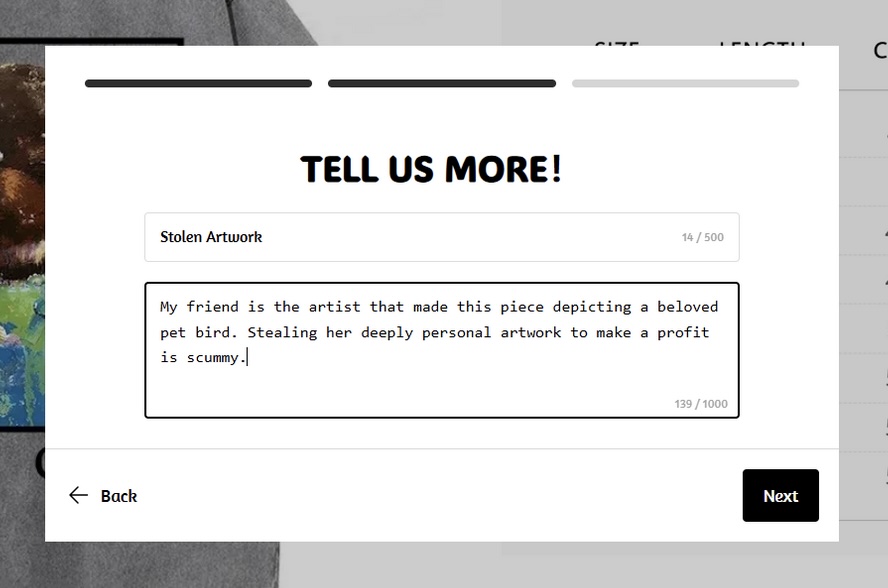
- Friends left comments on the Tokyo Canvas Facebook ad, calling out the theft.
- I reported the ad for violating my intellectual property rights, using the three little dots at the top right of the post.
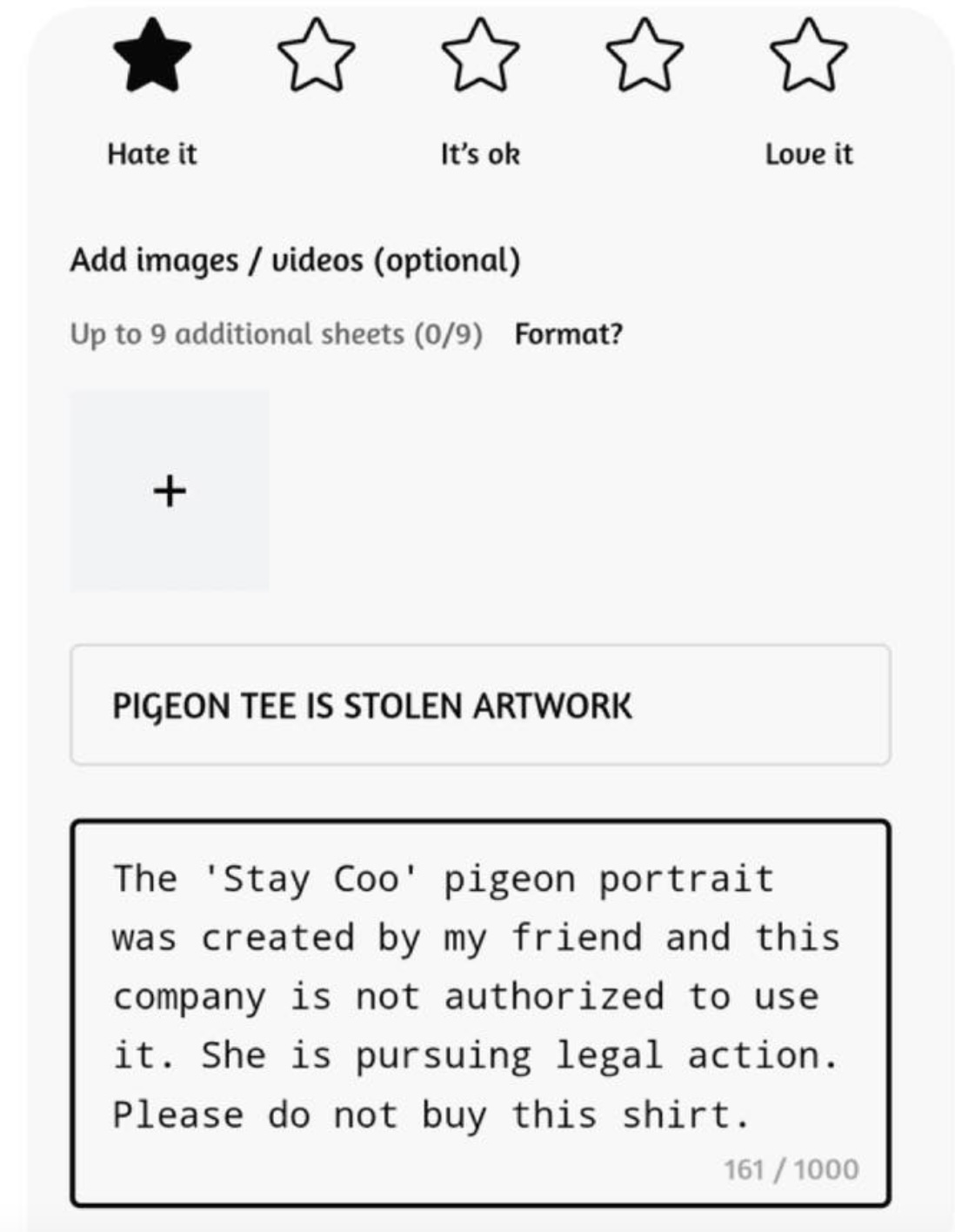
- I created a Facebook post asking people to leave one-star reviews on the Tokyo Canvas website and to shame them for stealing. To make it easy for people to take action, I included a link to the sales page and samples of what other friends had said.
It was hard to believe, but Facebook responded promptly to my report of the violation. Within 24 hours, I received a notice that they’d investigated and removed the ad. The next day, a friend who had visited the website to leave a negative review reported that the sales page was gone. I’ve never been so pleased to see a 404 error.
All of this occurred before Rich prepared my DMCA takedown notice. I might have stopped there, but I wasn’t ready to walk away from the claim (that is, lie) that they had sold more than 2,000 shirts using my portrait of Steve. I had watched the purported sales number jump from around 100 shirts at the beginning of the day to this ridiculous claim as more people viewed the page.
Consider a Cease and Desist Letter
Rich and I decided to send the DMCA takedown notice even though the company had already pulled the product from its website. We wanted to follow up with a cease and desist letter demanding artists’ royalties for the shirts they had “sold.” (To learn more about cease and desist letters, see Rich’s article, Dear Rich: What Should My Cease and Desist Letter Say?)
Before sending the cease and desist letter, to strengthen my claim, I registered Steve as a work of visual art with the U.S. Copyright Office. This process involved filling out a form, paying a $45 fee, and submitting a copy of the original work. (It sounds daunting, but it took only 20 minutes.) As mentioned above, the registration can act as a deterrent to potential thieves and is necessary to file a lawsuit. It can also bring pressure to bear when making a demand such as the one Rich and I were about to send.
Additionally, we each ordered one of the offending shirts as physical evidence of the theft. It would be proof that they had made a sale and profited from my design. There’s something perversely enjoyable about owning this illegal Steve shirt, although it’s the weirdest and most poorly made T-shirt I’ve ever worn.
You Can Always Ask
In the cease and desist letter, we demanded artists’ royalties of 10% on the sales numbers Tokyo Canvas claimed. At the same time, Rich curbed my enthusiasm for this part of the process, telling me we were unlikely to succeed because the company was shady. It used a new domain, had no physical address, and various sources had already flagged it for stealing or scamming. It would be difficult and expensive — in other words, not worth it — to try to pin them down.
In the end, the DMCA takedown notice underscored the actions of my Facebook friends, letting the Tokyo Canvas know we were serious. Their response was affirmative, if annoying:
Hi,
this product has been disabled. thanks
have a nice day.
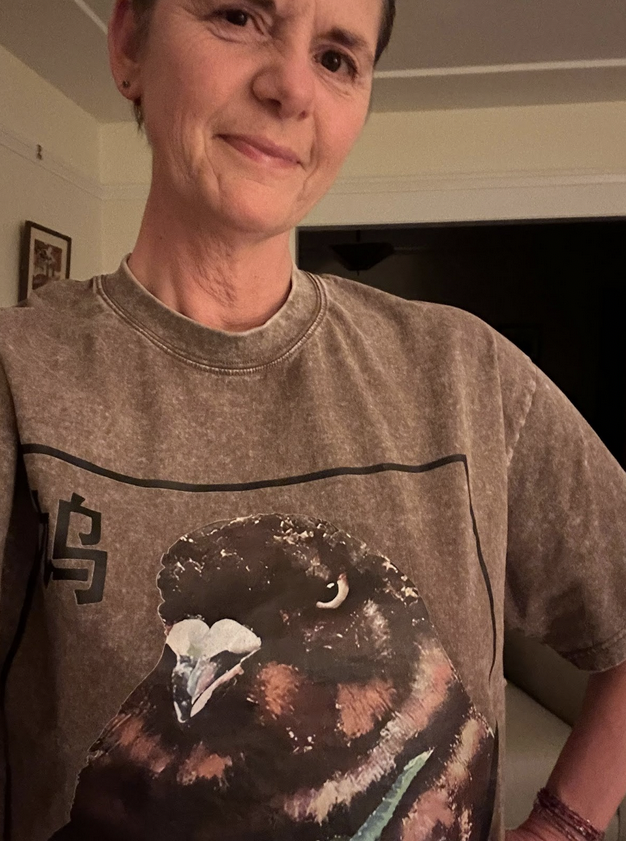
As of today, we’ve received no response to the cease and desist letter, and we don’t expect one. But I can let that go, knowing I’ve done all I can — and I’ve got an ugly shirt to prove it.
October Giveaway Signup
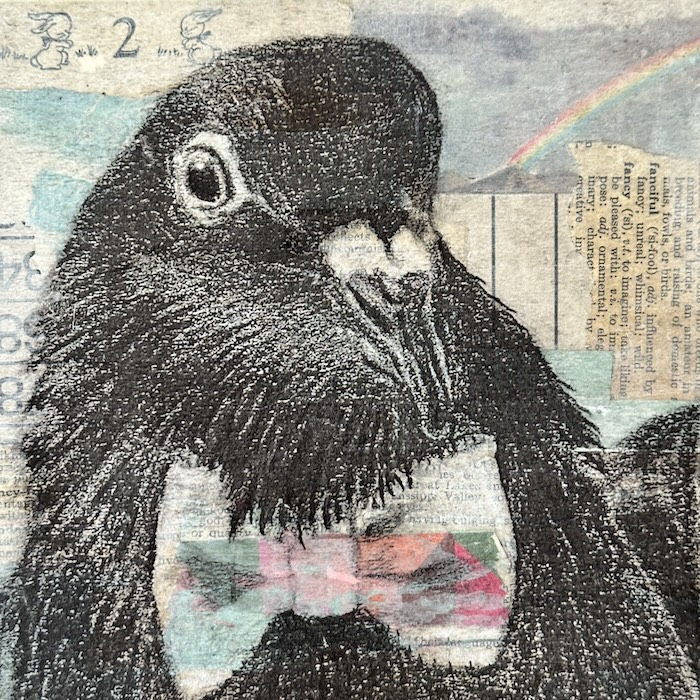
It’s been so long since I’ve posted anything that my whole giveaway situation fell apart. Life has been a lot lately! But I will hold my quarterly giveaway at the end of this month — in just a couple of weeks. So if you enter now you’ll have a great chance of winning. The prize is “Fancy,” a 6 x 6 image transfer of my original drawing of rescued feral pigeon Lucito on a collaged background. I mounted this piece on a scrap board painted turquoise blue, and it’s ready to hang. Win it for yourself or give it as a gift!
As always, here’s how to enter if you haven’t already:
- If you’re getting this post in your email inbox, reply to it and tell me you want to be included.
- If you’re reading this post on my website, subscribe to the blog and reply to your confirmation email.
Thanks for reading. I’ll be back here soon!
